
Earnings season has a rhythm. The calendar fills up, the prints land after the close, and everyone asks the same question: did the people running the company see this coming? Insider trading before earnings is where that question gets honest data, because Form 4 filings show what executives and directors actually did with their own money. Our Insider Sentiment Gauge reads the trailing 12 months of those filings, November 1, 2025 to October 6, 2026, and turns them into one verdict per ticker. One warning before the table: that window closes on October 6, weeks before the first of these reports. It is the last full window before the pre-earnings blackout, the stretch when company policies freeze insider trading altogether. Silence in the days right before a print is structural. It tells you nothing, and this article will not pretend otherwise.
The reporting window: who prints, and when
Start with the dates, all of them from our Q3 2026 earnings calendar. Tuesday, October 27: Boeing before the open, Visa after the close. Wednesday, October 28 is the week's center of gravity: Microsoft and Alphabet, both after the close, the pair our mega-cap week preview was built around. Thursday, October 29: Eli Lilly and Mastercard before the open, Amazon and Intel after the close. Friday, October 30: Exxon Mobil and Chevron before the open. The following week brings Apple and Palantir on Monday, November 2, both after the close, AMD on Tuesday, November 3, and Caterpillar and McDonald's on Wednesday, November 4. The season's tail is the biggest of all: Home Depot, Disney and Nvidia on Tuesday, November 17, and Walmart on Thursday, November 19. The banks and the streamers have already printed; our bank earnings kickoff and the Netflix and Tesla preview covered that end of the calendar.
The baselines: what the gauge recorded
The gauge's rule is printed on its page: a side needs 60 percent of traded dollars before it gets called, and only open-market buys and sells count. Across the reporters it covers, the buy column is empty everywhere, so every name below reads net selling by construction. That makes the verdict label the least interesting part of the table. The dollar figures and the trade counts are the story.
| Company | Reports | Sells | Buys | Net insider flow |
|---|---|---|---|---|
| Visa (V) | Tue Oct 27, after close | 2 | 0 | -$2,795,700 |
| Microsoft (MSFT) | Wed Oct 28, after close | 6 | 0 | -$20,764,845 |
| Alphabet (GOOGL) | Wed Oct 28, after close | 1 | 0 | -$28,257 |
| Amazon (AMZN) | Thu Oct 29, after close | 1 | 0 | -$251,500 |
| Apple (AAPL) | Mon Nov 2, after close | 14 | 0 | -$90,326,794 |
| Palantir (PLTR) | Mon Nov 2, after close | 8 | 0 | -$3,016,255 |
| AMD | Tue Nov 3, after close | 31 | 0 | -$56,828,822 |
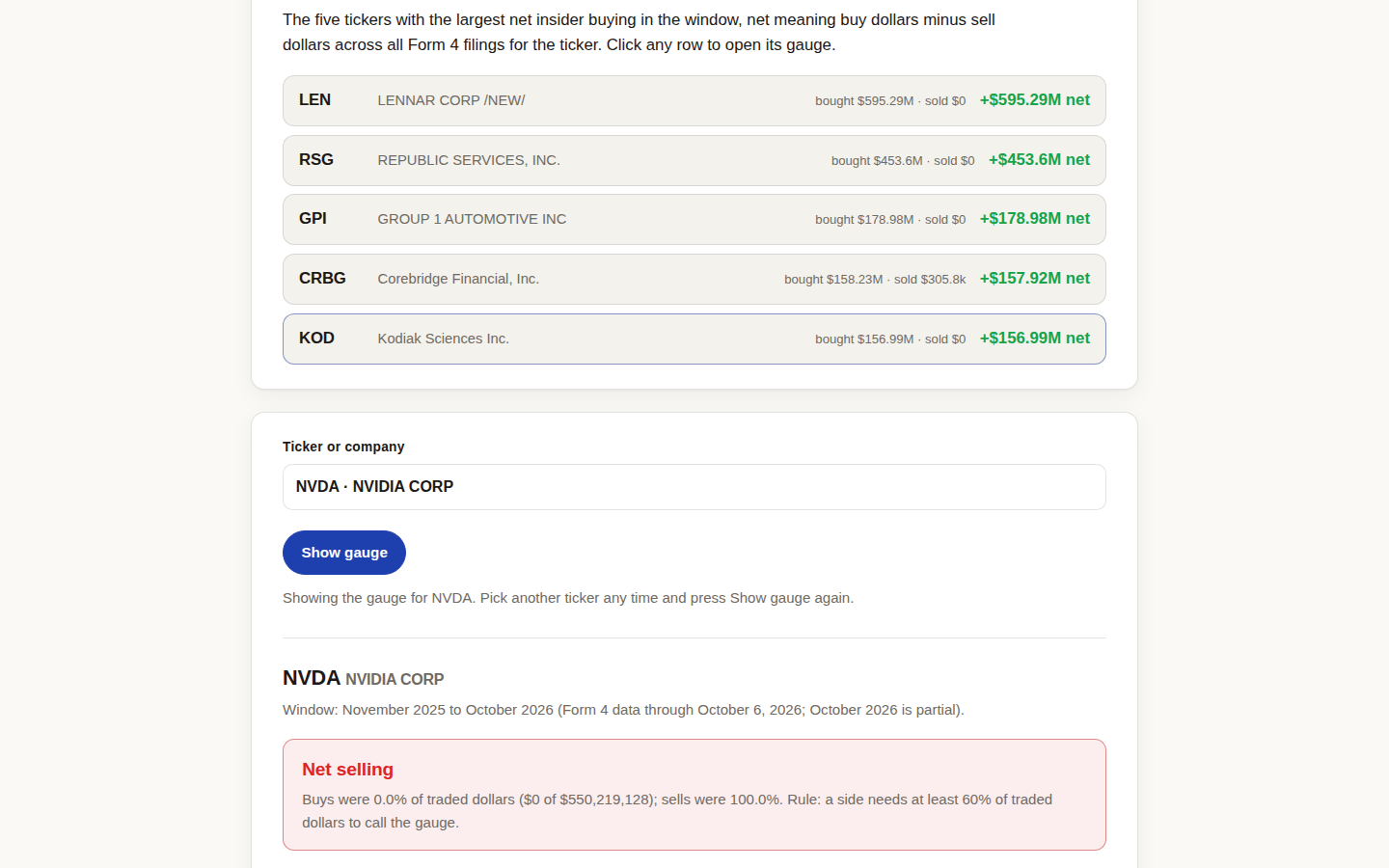
| Nvidia (NVDA) | Tue Nov 17, after close | 15 | 0 | -$550,219,128 |
| Home Depot (HD) | Tue Nov 17, before open | 1 | 0 | -$206,516 |
| Walmart (WMT) | Thu Nov 19, before open | 5 | 0 | -$2,125,760 |
| Meta (META) | Reported Wed Oct 21 | 52 | 0 | -$84,971,844 |
Three honest reads
1. Zero buys, everywhere
Not one open-market buy. Not at Microsoft, not at Apple, not at Nvidia, not at any of the eleven covered names, across a full twelve months. Before that sounds like a verdict, remember the base rate: the full dataset behind the gauge holds 7,170 sells against 1,890 buys, because executives sell for a working life's worth of ordinary reasons. Taxes come due when stock vests. A director with most of her wealth in one ticker diversifies. And a large share of the selling runs on 10b5-1 plans, schedules set months ahead that execute no matter what the quarter looks like. Insider buying and selling stocks is an asymmetric game: sales are routine, buys are the rarer and stronger signal, because nobody has to buy. The honest read of this table is not that insiders fled. It is that nobody stepped up to buy, and that absence is worth less than a single real buy would have been worth.
2. AMD has the breadth, Nvidia has the size
AMD's 31 sells are the broadest pattern among the names still to report, more separate sale filings than Apple (14) and Nvidia (15) combined. Nvidia's figure is the opposite shape: $550,219,128 of net selling, the largest number on the board by far, but the transactions table behind the gauge shows the biggest lines are one director, Mark A. Stevens, selling through September 2026. One person's program is not a chorus. Size tells you how much money moved. Breadth tells you how many people moved it. The two numbers answer different questions, and mixing them up is how a routine divestment turns into a scary headline.
3. The thin names mean nothing
Alphabet's entire window is one sell of $28,257. Amazon's is one sell of $251,500. Home Depot's is one sell, of $206,516. A single transaction is a person paying a tax bill or rebalancing a portfolio. It is not a signal, and we will not dress it up as one. Where the count in the table is one, the correct gauge reading is: no reading.
The names the gauge cannot speak for
Nine reporters in this window have no open-market buys or sells in the dataset at all: Boeing, Eli Lilly, Mastercard, Intel, Exxon Mobil, Chevron, Disney, Caterpillar and McDonald's. There is no gauge verdict for them. Not a neutral one, none. Absence of filings is not calm, and it is not confidence. It is just absence, and any tool that converts it into a score is inventing data. If one of those names is your position, the gauge has nothing to tell you this season, and saying so plainly is the whole point of publishing the baselines.
What to watch after the prints
The blackout ends with the report. Form 4 filings usually start moving again within days, and that first post-print window is where insider data earns its keep. An officer buying after a weak guide is spending real money on a public opinion. A fresh cluster of discretionary sells right after a beat says something too, and it says it louder than anything filed before the print. Our earnings season checks walk through that follow-through in order: write down the baselines from the table above now, then compare the first new filings against them once each name reports. Run the names you own before their dates arrive: open the Insider Sentiment Gauge. Everything here is informational only, drawn from public filings, and none of it is investment advice.