
Amazon's third quarter is the cleanest example of the season's central lesson: the print is not the story, the guide is. As Investing.com's report recorded it, Amazon posted $1.89 of EPS on $201.94 billion of revenue for Q3 2026. AWS, the segment the whole valuation leans on, grew over 39 percent year over year to $45.98 billion. By the standards of any normal quarter that is a triumph. The shares still fell more than 4 percent in early trading the next day, and had slid almost 7 percent after hours at the first read.
Where it missed
Two places. The EPS line itself came in under the $2.01 consensus Nasdaq's calendar carried, a negative surprise on the season's most-watched row. And the fourth-quarter revenue guidance, $240 billion to $247 billion, landed under what the Street had pencilled for the holiday quarter. In mega-cap season, the guide is the print: the market had already paid for the AWS growth, so the only new information was the softer holiday and what it implied about the consumer.
The $42 billion question
The number that followed Amazon through every write-up was negative $42.4 billion: trailing-twelve-month free cash flow, consumed by the AI build-out. That figure is the quarter's real debate. Bears read it as a capex spiral with returns pushed years out; bulls read the same AWS growth line, 39 percent and accelerating, as the return arriving early. Both sides are arguing about timing, not direction, which is why the stock's earnings-day move was a positioning event rather than a verdict.
How this site reads it
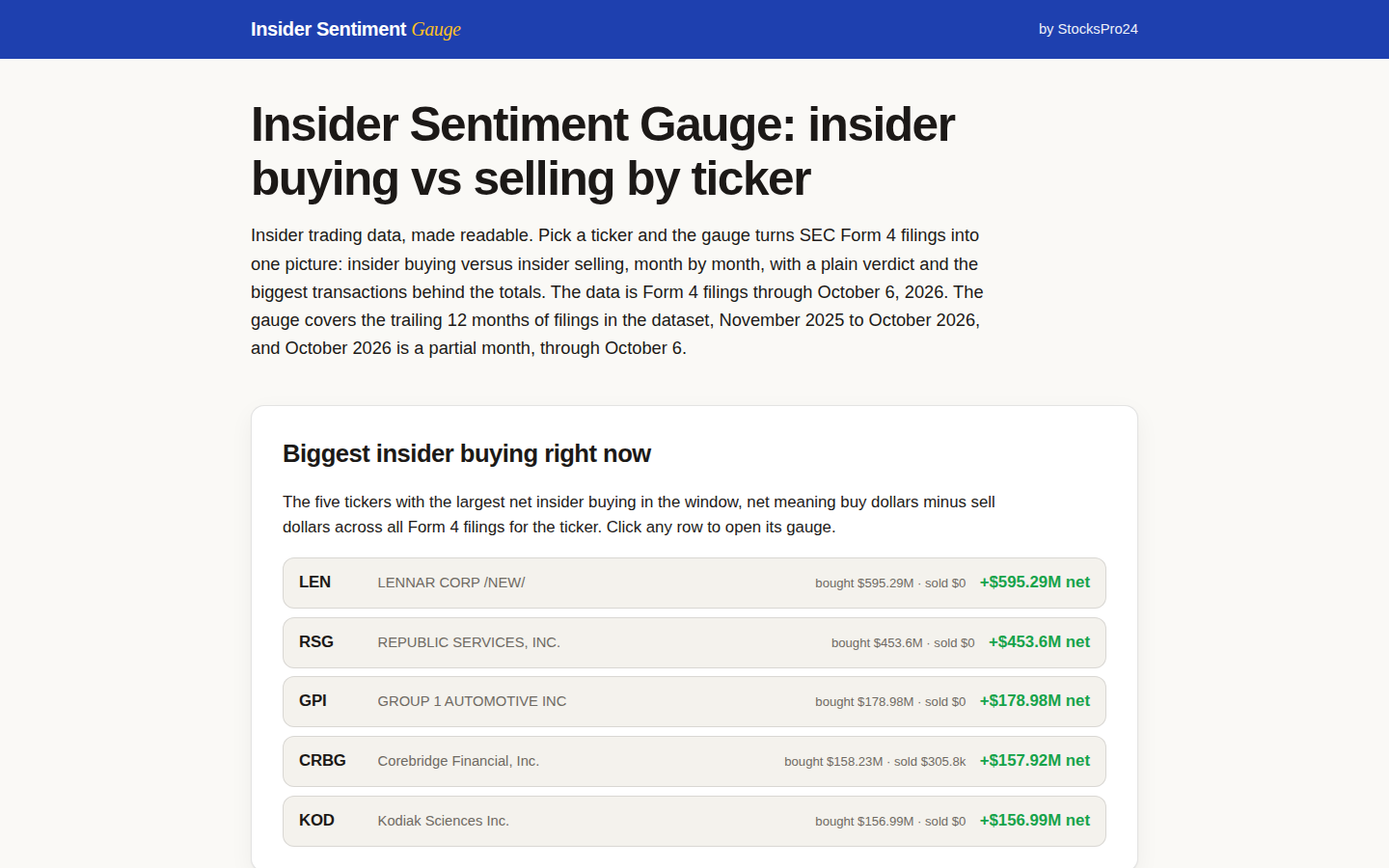
Our preview framed Amazon and Apple as late October's test; the recap discipline is to grade the test, not the mood. The test questions were AWS growth (passed, decisively), the holiday guide (failed, narrowly) and cash burn (unchanged, deliberately). Two of three, and the one failure was the one the market prices first. The Insider Sentiment Gauge shows the before picture for the next one: what Amazon's insiders did while the quarter was being built.